
Boloponera ikemkha
- Sci. Name
- Boloponera ikemkha
- Tribe
- Ponerini
- Subfamily
- Ponerinae
- Author
- Hawkes, 2018
- Distribution
- Found in 1 countries
Introduction
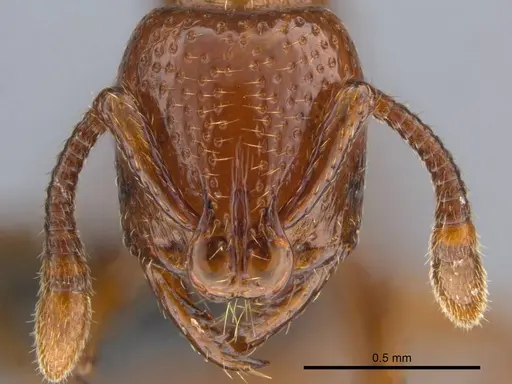
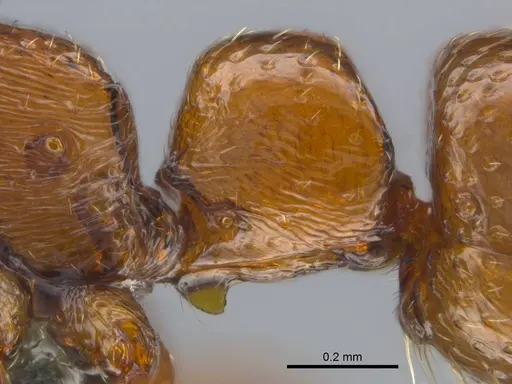
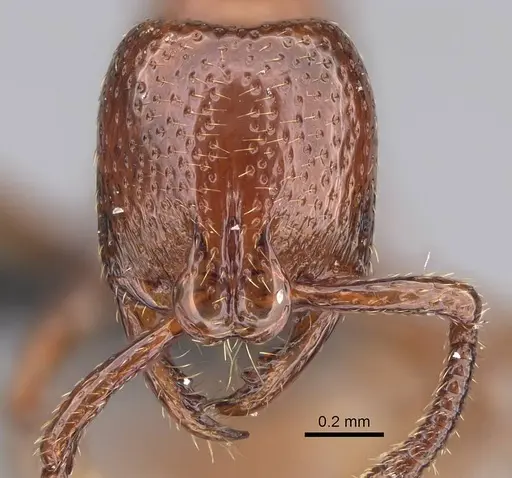
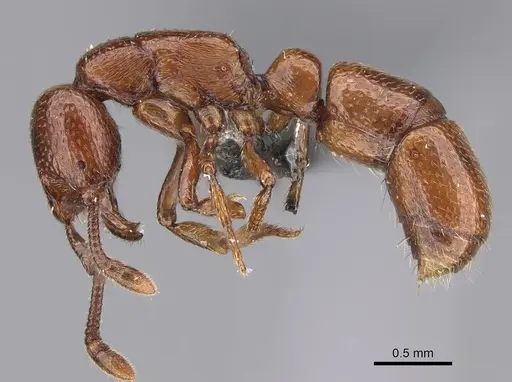
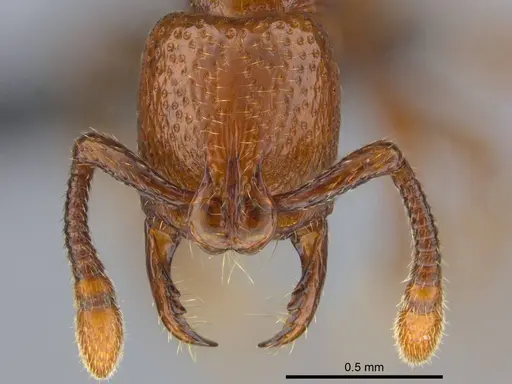
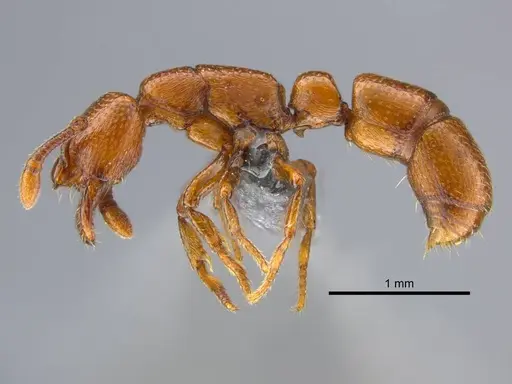
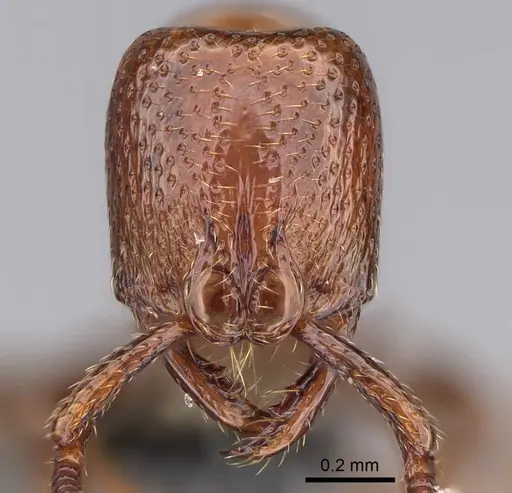
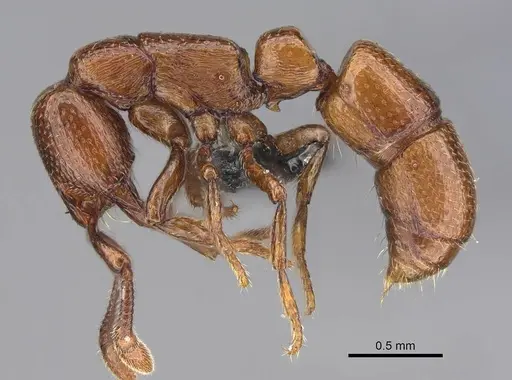
Boloponera ikemkha is an extraordinarily rare ant discovered in 2018 in northeastern South Africa. Workers measure just 3.35-3.42mm in total length, with a medium reddish-brown body and remarkably smooth, polished appearance - they lack the standing hairs found on most related species. The most striking feature is their enormous, gleaming torular lobes (the antennae sockets), which give this species its name meaning 'shining shield' in Ancient Egyptian. Unlike most ants, workers are completely eyeless, while the larger ergatoid queens (wingless reproductive females that develop from the worker caste) have tiny eyes with just 12-17 ommatidia. This species is only the second known in its genus, representing a 3400km range extension from the only other known Boloponera species found in Central Africa. The entire known population exists in a narrow strip of riparian woodland threatened by platinum mining operations, making this one of the world's rarest and most endangered ants .
Quick Summary
- Difficulty: Expert
- Origin & Habitat: Known only from a tiny riparian fringe area in Sekhukhune Mountain Bushveld, Limpopo Province, South Africa. This ant lives in a very narrow strip of moist riverine woodland with canopy under 10m, surrounded by much drier bushveld. The type locality sits at approximately 1025m elevation with mean annual rainfall of 718mm. This habitat is within the botanically rich Sekhukhuneland Centre of Plant Endemism, now increasingly threatened by mining activity [1].
- Colony Type: Appears to have single-queen colonies with ergatoid replacement reproductives (inferred from morphology). The larger specimens with eyes are interpreted as ergatoid queens, wingless reproductive females that develop from the worker caste, which would allow colony survival if the primary queen dies. True winged queens have not been documented [1].
- Size & Growth:
- Queen: 3.82-3.84mm ergatoid queens (larger than workers) [1]
- Worker: 3.35-3.42mm [1]
- Colony: Unknown but presumed very small based on related Ponerine patterns and the ergatoid queen system [1]
- Growth: Unknown, no captive colonies have been documented
- Development: Unknown, this species has never been kept in captivity (No development data exists.)
- Antkeeping:
- Temperature: Unknown, no captive data exists. Based on the South African habitat (moderate elevation, seasonal climate), a range of 20-26°C would be a reasonable starting point.
- Humidity: Likely requires high humidity given the riparian (riverine) habitat preference. The natural habitat is a moist fringe area within drier bushveld. Keep substrate consistently moist but not waterlogged.
- Diapause: Unknown, no data on overwintering requirements exists. The species occurs in a region with cool, dry winters, so some form of seasonal slowdown is possible but unconfirmed.
- Nesting: In the wild, colonies were found 10-15cm deep in soil at the base of trees. The species likely forages entirely underground. In captivity, a deeply filled test tube or naturalistic setup with moist soil would best approximate their natural conditions. Given their tiny size and underground habits, provide tight chambers and passages scaled to their 3-4mm body size.
- Behavior: Nothing is known about their behavior in captivity since this species has never been documented in antkeeping. In the wild, they likely forage entirely underground given the complete absence of eyes in workers. Ponerine ants are typically predatory, so expect them to hunt small invertebrates. Ergatoid queens cannot fly, they disperse on foot or perhaps with colony budding. This means escape risk is likely lower than flying species, but their tiny size still requires excellent containment. The sting is present but weakly curved [1].
- Common Issues: this species has never been kept in captivity, there is no care information available, the entire wild population faces imminent extinction threat from mining, keeping wild colonies may be unethical, ergatoid queens cannot fly, limiting their natural dispersal, colonies are extremely localized, no information exists on what foods this species accepts, tiny 3-4mm size makes escape prevention challenging despite limited mobility, the specialized riparian habitat cannot be easily replicated in captivity
Why This Species Is Not Recommended for Antkeepers
Boloponera ikemkha is one of the rarest ants on Earth and should not be kept in captivity under any circumstances. This species was only discovered in 2018 during an environmental impact assessment at a platinum mine, and fewer than ten specimens have ever been collected. The entire known global population exists in a tiny strip of riverine woodland spanning perhaps a few hundred meters, and this habitat faces immediate destruction from mining operations. The species has been classified as Critically Endangered under IUCN criteria. Beyond the ethical concerns, there is simply no information available about how to keep this ant alive. No one has ever documented captive care, accepted foods, temperature preferences, or any other basic husbandry requirements. The few specimens available for study were collected 10-15cm deep in soil at the base of trees, and the workers are completely eyeless, suggesting a completely subterranean lifestyle that would be nearly impossible to maintain in captivity. If you are interested in keeping Ponerine ants, there are many similar species with established care protocols that are appropriate for experienced keepers [1].
Identification and Distinguishing Features
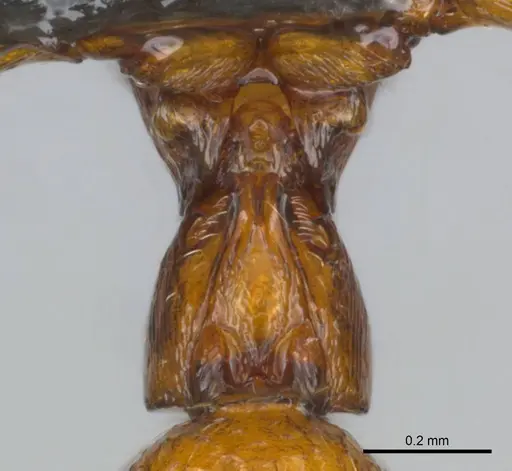
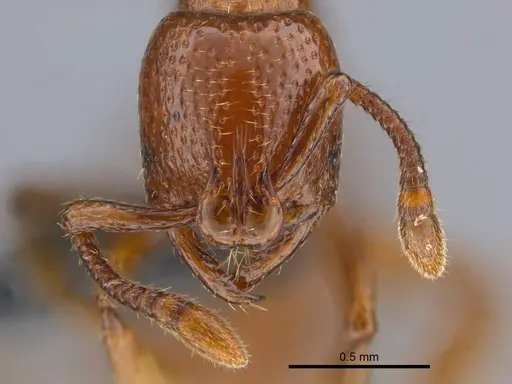
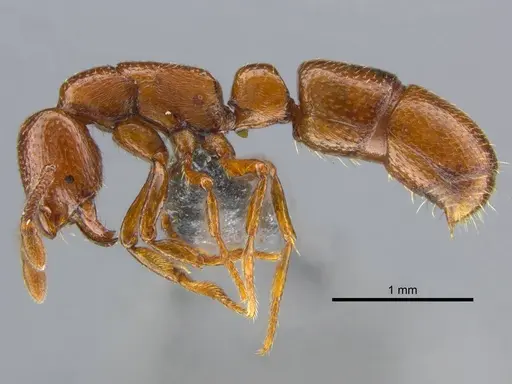
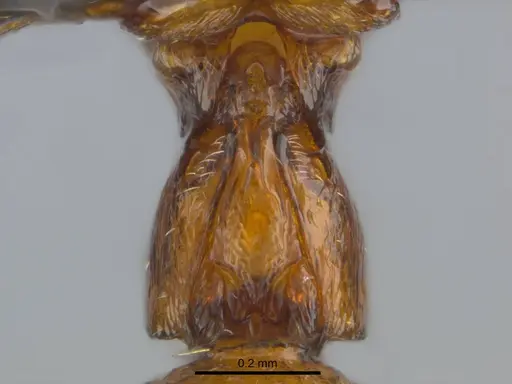
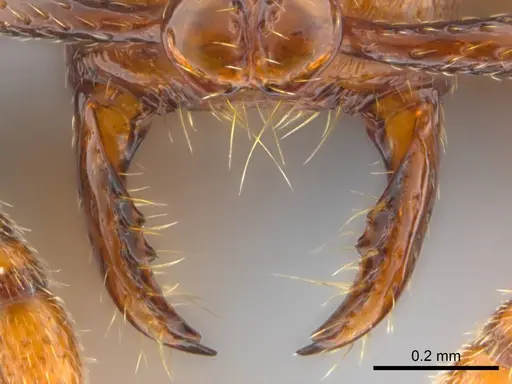
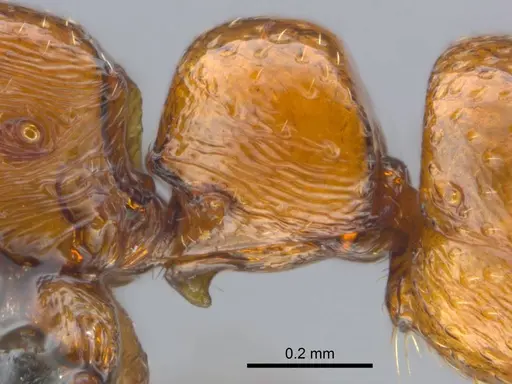
Boloponera ikemkha workers are tiny at just 3.35-3.42mm total length, making them one of the smaller Ponerine ants. The most diagnostic feature is the extremely large, highly polished torular lobes, the antennae sockets that appear as gleaming shields at the front of the head. Unlike the only other known Boloponera species (B. vicans from Central Africa), B. ikemkha has completely smooth and polished torular lobes without any striations, and lacks standing hairs on the scapes, mesosoma, petiole, and first gastral segment. Workers are completely eyeless, which is unusual among ants and suggests a fully subterranean lifestyle. The body is medium reddish-brown, with legs and the last two antennal segments slightly paler. The sting is present but weakly curved [1]. Ergatoid queens are slightly larger at 3.82-3.84mm and possess tiny compound eyes with 12-17 poorly defined ommatidia, along with relatively longer legs than workers [1].
Natural History and Habitat
This species is known only from a very narrow strip of riparian woodland in Sekhukhune Mountain Bushveld, Limpopo Province, South Africa. The habitat is a moist riverine fringe, a narrow strip of denser vegetation along a watercourse, that exists within a much larger area of drier bushveld. This explains why the species was never discovered before: it occupies an extremely restricted microhabitat within a botanically rich but geographically tiny area. The type locality sits at approximately 1025m elevation with mean annual rainfall around 718mm. The ants were collected by hand at 10-15cm depth in soil at the base of trees, confirming they live underground. Researchers believe the entire genus Boloponera forages underground, and this species appears to have very limited dispersal abilities due to its ergatoid (wingless) queens. The Sekhukhuneland Centre of Plant Endemism is recognized for its unique plant diversity but is increasingly threatened by mining operations, with at least eight operational mines within 8km of the type locality. The proposed tailings storage facility for Two Rivers Platinum Mine is located approximately 400m from the species' known habitat [1].
Colony Structure and Reproduction
Based on morphological analysis, Boloponera ikemkha appears to have an ergatoid queen system. The larger specimens with eyes are interpreted as ergatoid queens, reproductive females that develop from the worker caste rather than as distinct queen morphs. This is different from typical ants where winged queens develop separately. Ergatoid queens cannot fly, which explains why this species has such a restricted range, queens can only disperse by walking from the parent nest. The presence of ergatoids suggests a single-queen colony structure where one primary queen lays eggs, with ergatoid individuals serving as replacement reproductives if the main queen dies or becomes infertile. This is similar to some other Ponerine ants. The colony size is unknown but presumed to be small based on related species patterns and the ergatoid system. No winged queens have been documented, and nuptial flight behavior is completely unknown [1].
Taxonomic Context
Boloponera ikemkha is only the second known species in its genus, with the first (B. vicans) described from a single worker collected in the Central African Republic, a collection made over 3400km away. The genus Boloponera was established in 2016 from that single specimen, making B. ikemkha the second species to be described. The genus belongs to the subfamily Ponerinae, tribe Ponerini, a group that includes many predatory ants with powerful stings. However, B. ikemkha has a weakly developed sting that is unlikely to penetrate human skin [1]. The species name 'ikemkha' comes from Ancient Egyptian: 'ikem' means shield and 'kha' means shining, referring to the remarkably large and polished torular lobes that are the species' most distinctive feature. The name is a noun in apposition and does not change regardless of gender [1].
Frequently Asked Questions
Can I keep Boloponera ikemkha as a pet ant?
No. This species should not be kept in captivity. It is one of the rarest ants on Earth, known only from a tiny habitat threatened by mining, and has never been documented in captivity. There is no care information available, and collecting wild colonies would be both unethical and potentially illegal given their Critically Endangered status [1].
Where does Boloponera ikemkha live in the wild?
Only in a narrow strip of riparian woodland in Sekhukhune Mountain Bushveld, Limpopo Province, South Africa. This is an extremely restricted habitat, a moist riverine fringe within otherwise drier bushveld. The entire known global population exists in this tiny area [1].
How big are Boloponera ikemkha ants?
Workers are tiny at 3.35-3.42mm. Ergatoid queens are slightly larger at 3.82-3.84mm. These are among the smallest Ponerine ants [1].
Do Boloponera ikemkha workers have eyes?
No. Workers are completely eyeless, which is unusual among ants and suggests they live and forage entirely underground. The ergatoid queens have tiny eyes with only 12-17 ommatidia [1].
What makes Boloponera ikemkha special?
It is only the second known species in its genus, discovered in 2018. The entire global population exists in a tiny area threatened by platinum mining, making it one of the world's rarest and most endangered ants. It has remarkably large, polished antennae sockets and completely eyeless workers [1].
Do Boloponera ikemkha ants sting?
A sting is present but it is weakly curved and likely ineffective against humans [1].
How many queens does a Boloponera ikemkha colony have?
Appears to have single-queen colonies with ergatoid (wingless) replacement reproductives. The ergatoid queens cannot fly and serve as backup reproductives if the primary queen dies. True winged queens have not been documented [1].
What do Boloponera ikemkha eat?
Unknown. As a Ponerine ant, they would likely be predatory on small invertebrates, but no feeding observations exist. They likely forage entirely underground [1].
Is Boloponera ikemkha endangered?
Yes. The species has been classified as Critically Endangered (CR Blab(iii)+2ab(iii)) under IUCN Red List criteria. The only known habitat is threatened by a proposed tailings storage facility for a platinum mine located approximately 400 meters from where the species was found [1].
Why are they called 'ikemkha'?
The name comes from Ancient Egyptian: 'ikem' means shield and 'kha' means shining. It refers to the very large, highly polished torular lobes (antenna sockets) that are the species' most distinctive feature. The name is a noun in apposition [1].
Report an Issue
The current care sheet is based fully on literature. See inconsistencies, or something that's incorrect? Please , it will be resolved after review from an admin. Contributing to the blogs tab also helps providing information, to make us be able to further improve the caresheets. Thank you for your support!
References

This caresheet is licensed under CC BY-SA 4.0 .
Community Blogs
CASENT0254320
View on AntWeb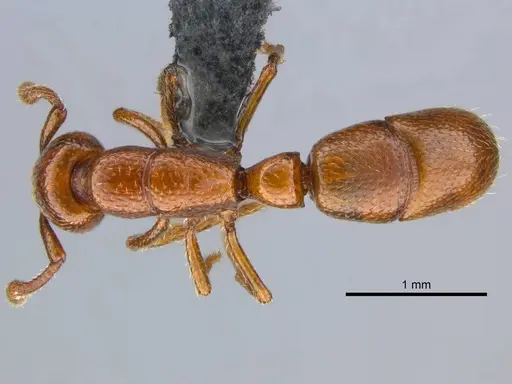
CASENT0254321
View on AntWeb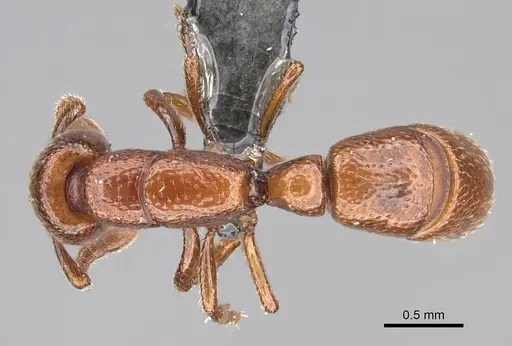
CASENT0254322
View on AntWeb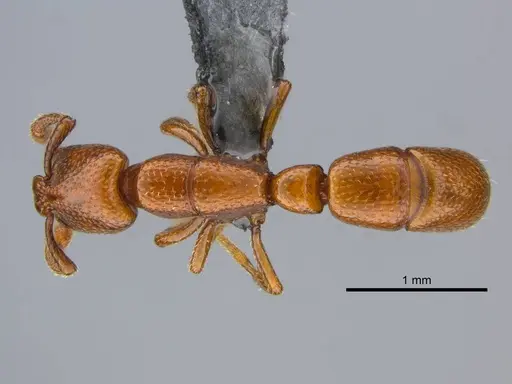
CASENT0254323
View on AntWeb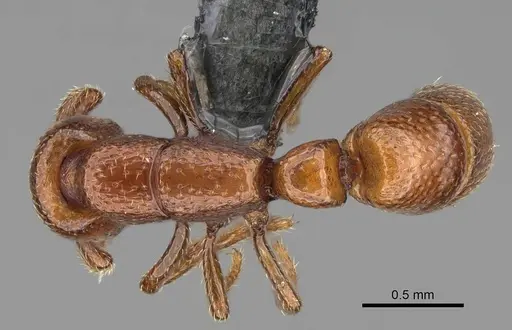
CASENT0257321
View on AntWeb
CASENT0257322
View on AntWeb
Literature
Loading distribution map...Loading products...