
Boloponera vicans
- Sci. Name
- Boloponera vicans
- Tribe
- Ponerini
- Subfamily
- Ponerinae
- Author
- Fisher, 2006
- Distribution
- Found in 0 countries
Introduction
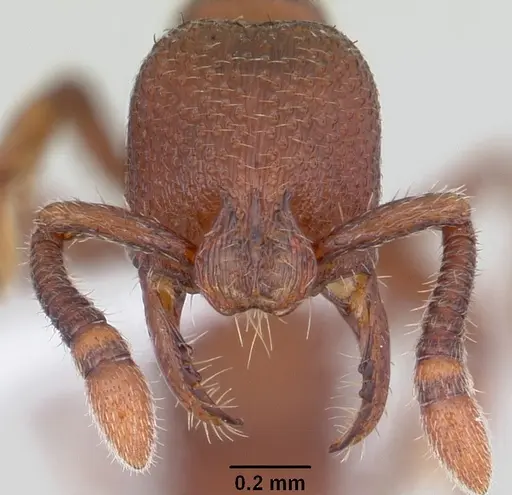
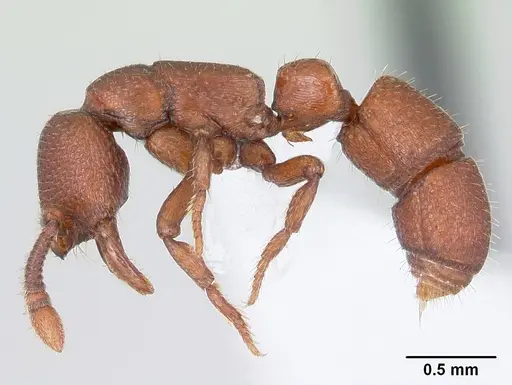
Boloponera vicans is one of the rarest ants in the world, known only from a single worker specimen collected in 2001 from the rainforests of the Central African Republic. This tiny ponerine ant measures just 3.3mm in total length and possesses a suite of unusual features that set it apart from all other known ants. Most notably, it completely lacks eyes - a trait indicating it lives entirely in dark microhabitats beneath the forest floor. Its linear mandibles suggest specialized hunting behavior, though what exactly it preys upon remains completely unknown. The abdomen shows a dramatic constriction between segments, and the body is covered in distinctive foveolate punctures with small hairs emerging from each puncture. This species represents a genus so rare and poorly understood that no additional specimens have been found since its initial discovery, despite targeted collecting efforts in similar habitats across Central Africa .
Quick Summary
- Difficulty: Expert, Research Only
- Origin & Habitat: Central African Republic, Sangha-Mbaéré Prefecture, Parc National Dzanga-Ndoki, Mabéa Bai at 510m elevation in lowland tropical rainforest. The area receives approximately 1621mm mean annual rainfall and is part of the Central African rainforest belt near the borders of Gabon, Cameroon, and Congo [2][1].
- Colony Type: Unknown, only a single worker specimen has ever been collected. No queen, no brood, no colony structure has been documented. The species is known only from the worker caste [1].
- Size & Growth:
- Antkeeping:
- Temperature: Unknown, no captive data exists. Based on habitat (Central African rainforest), likely requires warm, humid conditions in the mid-to-high 20s°C range, but this is purely speculative.
- Humidity: Unknown, the species was collected from leaf litter in lowland rainforest, suggesting high ambient humidity. However, specific moisture requirements are unstudied.
- Diapause: Unknown, no seasonal data exists
- Nesting: Unknown, the species was collected from sifted leaf litter using miniWinkler extraction, suggesting it lives in the forest floor layer. The absence of eyes indicates cryptic, subterranean nesting behavior. No specific nest structure has been documented [1].
- Behavior: Completely unstudied. The absence of eyes indicates a cryptobiotic, subterranean lifestyle similar to other blind ponerine ants. Linear mandibles suggest specialized predatory behavior, possibly on soft-bodied prey. No observations on aggression, foraging, or colony structure exist. As a member of Ponerinae, it likely possesses a stinger, but no stinging behavior has been documented. Escape risk cannot be assessed due to lack of captive specimens.
- Common Issues: This species has never been kept in captivity, no established care protocols exist., Only a single worker specimen exists in scientific collections, making wild collection extremely unlikely., The species may be extremely rare or locally distributed, possibly already extinct., No prey preferences are known, feeding requirements cannot be determined., The lack of eyes suggests specialized environmental needs that would be difficult to replicate.
Discovery and Rarity
Boloponera vicans was first described in 2006 by Brian L. Fisher based on a single worker specimen collected in May 2001 from the Mabéa Bai forest clearing in the Central African Republic. The specimen was obtained using miniWinkler extraction of sifted leaf litter, a standard method for collecting tiny forest-floor arthropods. What makes this species extraordinary is that despite extensive ant collecting efforts across Central Africa over the past two decades, no additional specimens have been found. This single worker represents the entirety of our knowledge about the species. The genus Boloponera is so distinct that it was placed in its own genus within the Plectroctena genus group of Ponerini, sharing linear mandibles and other features with Plectroctena but differing in key morphological aspects [1].
Unique Morphology
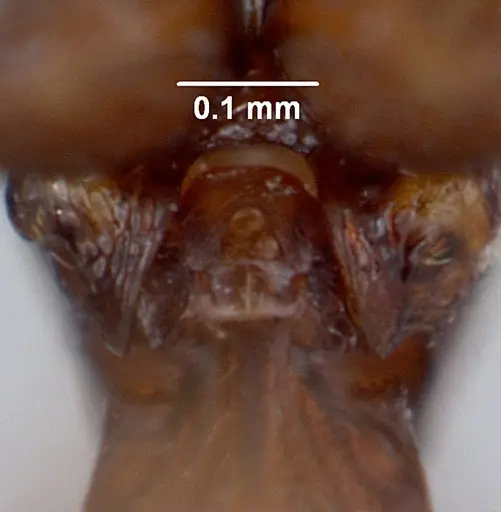
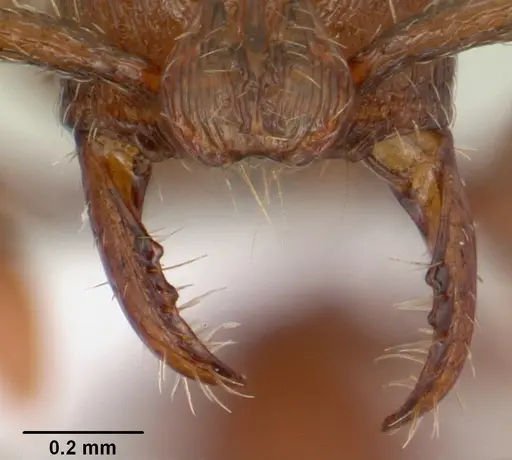
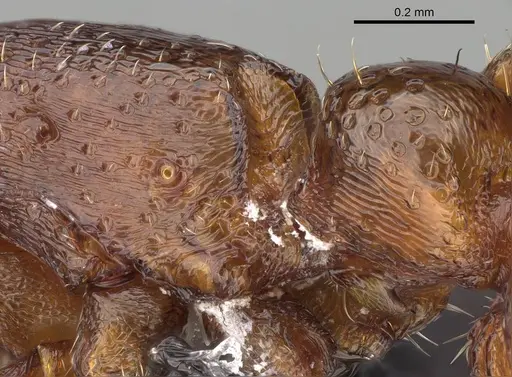
The holotype worker measures just 3.3mm total length, making it a tiny ant by ponerine standards. Its most striking feature is the complete absence of eyes, a trait indicating complete adaptation to life in darkness. The mandibles are linear and relatively simple, bearing two small blunt teeth on the inner margin in the basal half. This mandible structure suggests the species may specialize on particular types of soft-bodied prey, though no direct observations exist. The body surface is densely covered in foveolate punctures, each containing a small suberect hair, giving the ant a distinctive textured appearance. The abdomen shows a dramatic constriction between the third and fourth abdominal segments. The metafemur bears a longitudinal glandular groove along its entire length, a feature shared with its closest relatives in Plectroctena [1].
Habitat and Ecology
The type locality is in the Parc National Dzanga-Ndoki, a protected area within the Central African rainforest belt at approximately 510m elevation. The region experiences mean annual rainfall of around 1621mm, characteristic of lowland tropical rainforest. The specimen was collected from sifted leaf litter, the decomposing layer on the forest floor, using miniWinkler extraction. This collecting method suggests the species lives entirely within the leaf litter layer or immediately beneath it, rather than in above-ground nests. The complete absence of eyes confirms it is cryptobiotic, living in dark, humid microhabitats completely sheltered from light. What it eats, how it hunts, whether it lives in colonies or as solitary predators, and virtually every aspect of its biology remains completely unknown [2][1].
Captive Keeping Status
Boloponera vicans is not available in the antkeeping hobby and has never been kept in captivity. The species is known from a single scientific specimen collected over 20 years ago, and no additional specimens have been found despite targeted surveys. This makes it essentially impossible to acquire for captive keeping, even for the most dedicated antkeepers. The species would likely present extreme challenges if it were somehow obtained: specialized prey requirements (unknown), specific humidity needs (unknown), possible subterranean nesting (unconfirmed), and potentially colony structures or behaviors that would be impossible to replicate without wild specimens to study. For these reasons, Boloponera vicans remains purely a species of scientific interest rather than one suitable for captive husbandry. Antkeepers interested in rare ponerines should consider better-documented species within the Ponerinae subfamily that are available through reputable suppliers or can be ethically collected from the wild [1][2].
Frequently Asked Questions
Can I keep Boloponera vicans ants at home?
No. This species has never been kept in captivity and is essentially unavailable to antkeepers. Only a single worker specimen has ever been collected, and no additional specimens have been found since 2001. Even if you somehow obtained one, no care protocols exist because we know nothing about its biology.
Where does Boloponera vicans live in the wild?
It is known only from the Central African Republic, specifically from the Parc National Dzanga-Ndoki near the border region with Gabon and Cameroon. The single known specimen came from leaf litter in lowland tropical rainforest at 510m elevation.
What do Boloponera vicans eat?
Unknown. The linear mandibles suggest specialized predatory behavior, possibly on soft-bodied prey, but no direct observations of feeding exist. The species has never been observed hunting, foraging, or consuming any food in the wild or captivity.
How big do Boloponera vicans colonies get?
Unknown. We have no colony data whatsoever, only a single worker specimen exists. Even basic questions like whether they live in colonies or are solitary predators remain completely unstudied.
Do Boloponera vicans ants have eyes?
No. The species completely lacks eyes, indicating it is cryptobiotic, adapted to life in complete darkness beneath the forest floor or within soil. This makes it similar to other subterranean ant species.
How long does it take for Boloponera vicans to develop from egg to worker?
Unknown. No eggs, larvae, pupae, or brood of any kind have ever been documented for this species. The entire developmental cycle is completely unstudied.
What temperature and humidity do Boloponera vicans need?
Unknown. While the species comes from Central African rainforest (warm, humid conditions), no specific requirements have been established. Replicating the exact conditions of their cryptic leaf-litter habitat would be extremely challenging without basic biological data.
Why is Boloponera vicans so rare?
The species may naturally exist at extremely low population densities, be restricted to very specific microhabitats that are difficult to sample, or possibly be already extinct. Despite extensive ant surveys across Central Africa, no additional specimens have been found since 2001. This pattern suggests either genuine rarity or highly specialized habitat requirements that standard collecting methods fail to capture.
Can I find Boloponera vicans in the wild and catch them?
Extremely unlikely. The species has never been found again despite scientific collecting efforts in its known range. Even professional entomologists have failed to locate additional specimens. The habitat (protected rainforest in the Central African Republic) would also present significant practical challenges to any collection attempt.
Report an Issue
The current care sheet is based fully on literature. See inconsistencies, or something that's incorrect? Please , it will be resolved after review from an admin. Contributing to the blogs tab also helps providing information, to make us be able to further improve the caresheets. Thank you for your support!
References

This caresheet is licensed under CC BY-SA 4.0 .
Community Blogs
CASENT0401737
View on AntWeb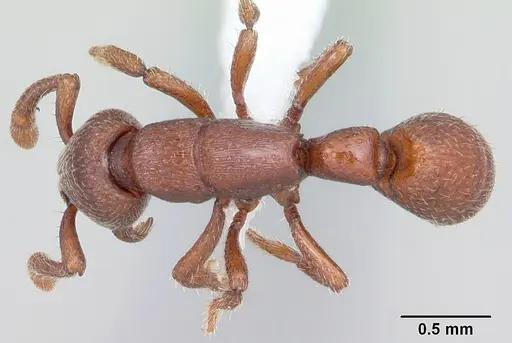
Literature
Loading distribution map...Loading products...