
Opamyrma hungvuong
- Sci. Name
- Opamyrma hungvuong
- Tribe
- Opamyrmini
- Subfamily
- Leptanillinae
- Author
- Yamane <i>et al.</i>, 2008
- Distribution
- Found in 2 countries
Introduction
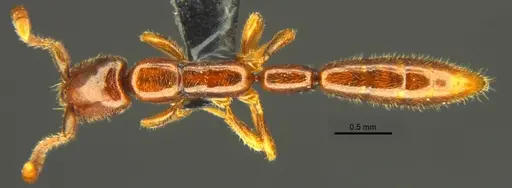
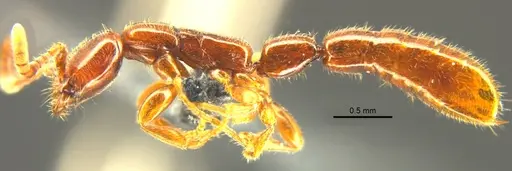
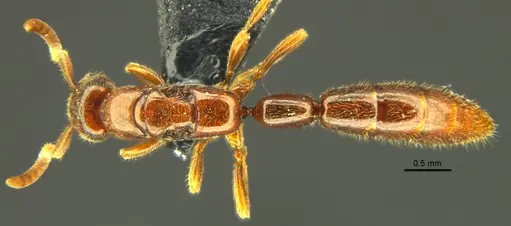
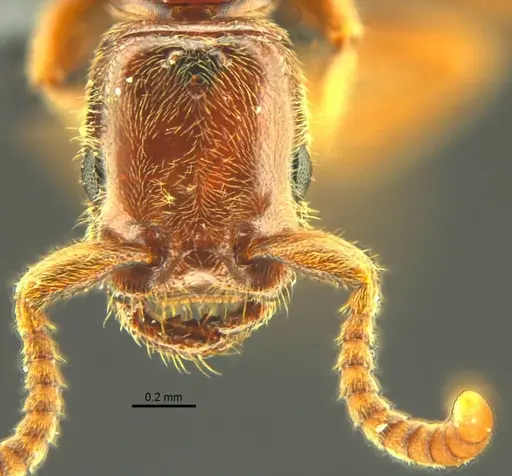
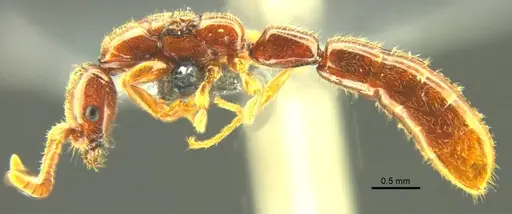
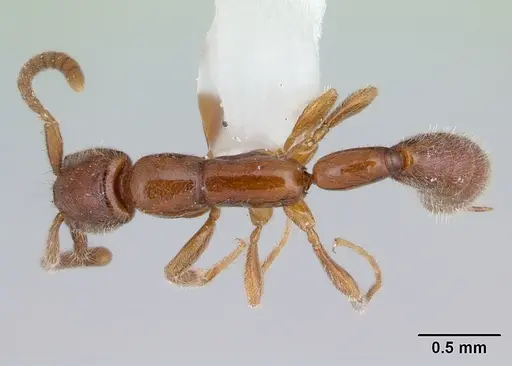
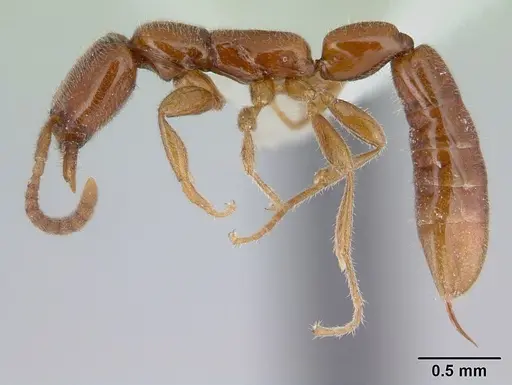
Opamyrma hungvuong is the only species in its genus. Workers are about 3.5-4 mm long, pale brown, and completely blind . They are specialized centipede predators, with both workers and queens hunting and paralyzing centipedes using a long, barbed sting . The metasoma is unusually elongated and laterally flattened, giving them a distinctive appearance . This species represents the earliest branching lineage within the Leptanillinae subfamily . Found in mountainous forests of northern Vietnam and southern China, they live subterranean lives in soil, constructing narrow tunnels . Colonies are polygynous with multiple queens, and both castes participate in hunting .
Quick Summary
- Difficulty: Expert
- Origin & Habitat: Mountainous forests of northern Vietnam and southern China (Hainan, Guangxi, Sichuan, Zhejiang) at elevations of 640-1500m, in soil on forest floor in subtropical evergreen broadleaf forest [1][2][4].
- Colony Type: Polygyne (multiple queens), colonies found with up to 69 dealate and alate queens. Workers and multiple queens actively participate in hunting [1].
- Size & Growth:
- Queen: ~5.1-5.4 mm [1]
- Worker: ~3.5-4.0 mm [1]
- Colony: Up to 27 workers plus multiple queens in largest recorded colony [1]
- Growth: Unknown, no immatures have been found in any collected colony [1]
- Development: Unknown, development has never been observed. No larvae or pupae were found in any collected colony [1] (Colonies collected in March had no immatures, suggesting either very seasonal breeding or underground development that escapes standard collection methods)
- Antkeeping:
- Temperature: Unconfirmed, based on similar Leptanillinae and subtropical forest habitat, aim for stable conditions around 20-25°C
- Humidity: Keep nest substrate consistently moist but not waterlogged, as they are subterranean ants [1]
- Diapause: Unknown, no data on overwintering requirements [2]
- Nesting: Subterranean, in soil with narrow tunnels. Use a naturalistic setup with damp substrate, they do not climb smooth surfaces well [1]
- Behavior: Extremely aggressive predators. Both workers and queens hunt centipedes, grasping prey appendages to restrain movement, then stinging swiftly. Queens participate in hunting alongside workers. They are strictly subterranean and blind, with a fully functional barbed sting [1][2].
- Common Issues: extreme rarity makes obtaining this species nearly impossible, specialized diet requirement, they only accept certain centipedes, not standard ant foods, no documented captive breeding success, colonies collected in the wild have no immatures, multiple queens required, single-queen colonies likely fail, some centipede prey can kill them with chemical defenses, completely blind and subterranean, standard observation is impossible
The Centipede Hunter
Opamyrma hungvuong is a specialized predator that targets almost exclusively centipedes. In laboratory observations, they successfully paralyzed geophilomorph centipedes like Mecistocephalus (about 40 mm), lithobiomorph centipedes like Lithobius (about 10 mm), and juvenile scolopendromorph centipedes like Scolopocryptops [1]. They ignored millipedes entirely. The hunting method is dramatic: ants grasp the prey's legs or antennae with their mandibles to immobilize it, then deliver a swift sting that takes about one second [1]. The sting remains embedded in the prey body, and ants often remain attached only by their sting. They target the prey's head venter specifically, grasping the base of antennae and stinging multiple times [1]. After paralysis, workers and queens lick hemolymph from wounds in the prey's body [1]. This specialization means captive feeding is extremely challenging, you would need a constant supply of specific centipede species.
Colony Structure and Reproduction
This species has an unusual colony structure. Colonies are polygynous, meaning they have multiple queens. The largest colony found had 69 dealate and alate queens with only 27 workers [1]. Queens have 6-7 ovarioles each, but none of the dissected queens had developed eggs or sperm in their spermatheca, suggesting they had not yet mated or were in a non-reproductive state [1]. A solitary dealate queen was found approximately 7 meters from a major colony, suggesting new colonies may be founded independently [1]. Most remarkably, no immatures (larvae, pupae, or eggs) have ever been found in any collected colony, despite collecting multiple colonies [1]. This suggests either extremely seasonal breeding tied to specific times of year, or that brood development happens underground where standard collection methods cannot reach them.
Morphology and Identification
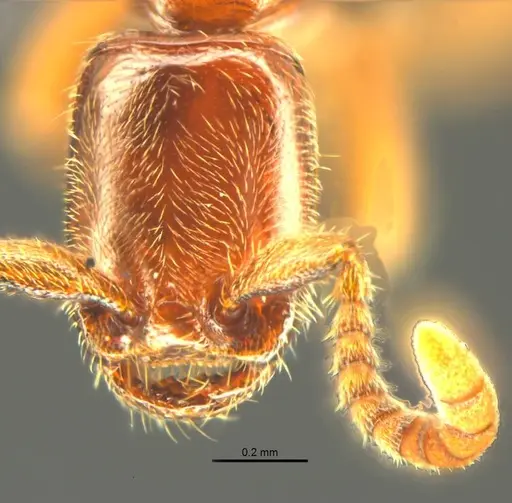
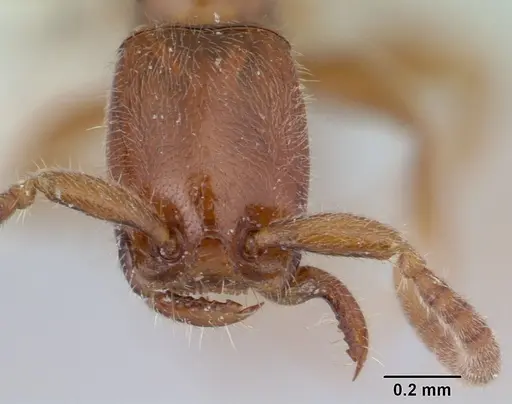
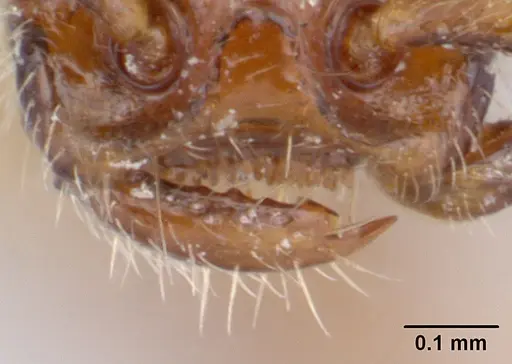
This is a tiny ant, workers measure just about 3.5-4 mm total length, while queens reach about 5.1-5.4 mm [1]. They are completely blind (no eyes) and have a single-segmented waist (petiole), which is unusual within Leptanillinae [2][5]. The most distinctive feature is their extremely elongated and laterally compressed metasoma (gaster), which gives them an almost worm-like appearance [2]. This flattening increases sting reach and allows stinging while grasping prey. The sting apparatus is fully developed with barbs on the lancets [2]. Body color is light brown with slightly yellowish antennae and legs [2]. The labrum has multiple rows of peg-like teeth that help grip active prey [2]. Males are known and have reduced wing venation with only three closed cells [2].
Distribution and Rarity
Opamyrma hungvuong is known from only a handful of localities across northern Vietnam and southern China. The species was first described in 2008 from two workers collected in Ha Tinh Province, Vietnam [2]. Subsequent records came from Nghe An Province (Vietnam), Hainan Island, Guangxi, and most recently Sichuan Province and potentially Zhejiang Province [4][2]. All records come from mountainous areas at elevations between 640m and 1500m in subtropical evergreen broadleaf forest [1][2]. The species is considered one of the rarest ants in the world, with fewer than 100 individuals ever collected [1]. This rarity, combined with their subterranean lifestyle and specialized habitat requirements, makes them essentially unavailable to antkeepers.
Frequently Asked Questions
Can I keep Opamyrma hungvuong as a pet ant?
No. This species is one of the rarest ants in the world, known from only a handful of specimens across Vietnam and southern China [1]. No captive colonies exist in the ant-keeping hobby, and no one has ever documented successful captive breeding [1]. Additionally, their extreme dietary specialization (centipedes only) makes keeping them essentially impossible for hobbyists [1]. They should be appreciated from a distance through scientific literature.
What do Opamyrma hungvuong eat?
They are extreme specialists that only eat centipedes. In documented observations, they successfully hunted and paralyzed geophilomorph centipedes (Mecistocephalus), lithobiomorph centipedes (Lithobius), and juvenile scolopendromorph centipedes (Scolopocryptops) [1]. They completely ignored millipedes. Some centipede species (like Strigamia) have chemical defenses that can kill the ants, two queens and eight workers died attempting to hunt this species [1]. Standard ant foods like sugar water, mealworms, or honeydew are NOT accepted.
How big do Opamyrma hungvuong colonies get?
Based on field collections, colonies remain small. The largest colony found had only 27 workers plus 69 queens [1]. No colony has ever been found with more than a few dozen workers. This is consistent with their specialized predatory lifestyle and possibly reflects their recent discovery, colonies may simply not have been found yet, or they may naturally maintain small worker populations [1].
Do Opamyrma hungvuong queens help with hunting?
Yes, unlike most ant species where only workers forage, both workers AND queens actively participate in hunting centipedes [1]. A solitary dealate queen was observed successfully paralyzing a juvenile centipede that was approximately twice her body length [1]. This is unusual behavior in ants and suggests queens remain active foragers rather than staying in the nest once established.
Why have no larvae or pupae ever been found?
This remains one of the great mysteries of this species. Multiple colonies have been collected from different locations and seasons, yet none have ever contained eggs, larvae, pupae, or cocoons [1]. Possible explanations include: extremely seasonal breeding that occurs at specific times of year not yet captured by collectors, underground development in deep nests that standard collection cannot reach, or the colonies observed were in a non-reproductive state (perhaps recently founded or between broods). The March collection had no immatures, suggesting breeding may occur at other times [1].
Do Opamyrma hungvuong ants sting?
Yes, and their sting is unusually well-developed for an ant. They have a long, up-curved sting with barbs on the lancets, which is rare among ants [2]. The sting is fully functional and they use it aggressively to paralyze centipedes [1]. The sting remains embedded in prey after successful stings, and ants often remain attached only by the sting. While their sting is effective against centipedes, the ants are too small to penetrate human skin [2][1].
What is the colony structure of Opamyrma hungvuong?
They are polygynous, meaning colonies have multiple queens. The largest colony found had 69 dealate and alate queens with only 27 workers, an extremely high queen-to-worker ratio [1]. Queens appear to remain active foragers rather than staying in the nest, and multiple queens can coexist in a single colony. This is different from most ants which typically have single queens after founding [1].
Where does Opamyrma hungvuong live?
They are strictly subterranean, living in soil on forest floors in mountainous areas of northern Vietnam and southern China [1][2]. They construct narrow tunnels in soil and are rarely found on the surface. Workers are blind (no eyes) and do not climb well on smooth surfaces. They prefer damp forest floor habitat at elevations between 640m and 1500m in subtropical evergreen broadleaf forest [1][2].
Are Opamyrma hungvuong dangerous to keep?
While they have a functional sting, the ants are too small (3-4 mm workers) to penetrate human skin [1]. The real danger would be to the ants, their extreme rarity, specialized diet, and unknown breeding requirements mean they would almost certainly die in captivity [1]. Additionally, attempting to keep them could contribute to pressure on wild populations of one of the world's rarest ant species [1].
Can I find Opamyrma hungvuong in my area?
No. This species is known only from a very limited range in northern Vietnam and southern China (Hainan, Guangxi, Sichuan, and possibly Zhejiang provinces) [4][2]. They have never been recorded outside this region. Even within this range, they are extraordinarily rare, only a handful of specimens have ever been collected despite over 20 years of ant research in the area [4][2].
Report an Issue
The current care sheet is based fully on literature. See inconsistencies, or something that's incorrect? Please , it will be resolved after review from an admin. Contributing to the blogs tab also helps providing information, to make us be able to further improve the caresheets. Thank you for your support!
References

This caresheet is licensed under CC BY-SA 4.0 .
Community Blogs
Literature
Loading distribution map...Loading products...